Did Venus Once Have Oceans?
The science behind an extraordinary possibility
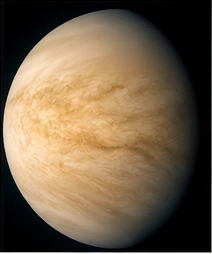
A familiar planet, an unfamiliar world
Venus is nearly Earth's size and formed in the same solar system from broadly similar materials. Yet today's Venus is profoundly hostile: its dense carbon-dioxide atmosphere produces surface temperatures hot enough to melt lead, and its surface pressure is roughly ninety times that of Earth's at sea level. Those conditions invite an obvious question. Was Venus always like this, or did a less hostile world precede the one we know?
For me, that question is the doorway into The Venus Prophecy. The books begin with scientific curiosity, not with a claim that the mystery has been solved. The thought that an apparently lifeless planet might carry traces of a different past offers extraordinary possibilities for fiction.
What the observations actually tell us
Scientists have measured an unusually high ratio of deuterium, a heavier form of hydrogen, to ordinary hydrogen in Venus's atmosphere. Because lighter hydrogen escapes more readily into space, that ratio is consistent with substantial water loss over time. It is an important clue—but not a preserved shoreline, a recovered seashell, or direct proof that an ocean once covered the surface.
Radar observations have mapped plains, volcanoes, mountainous regions, and rugged tessera terrain through the thick clouds. These landscapes record a complicated geological history. Some researchers have considered whether particular ancient rocks might reveal interactions with water; their precise composition and origin remain uncertain. The present surface has been dramatically altered, so evidence of an earlier climate would be difficult to read even if it existed.

The case for an ancient ocean
Climate models provide one plausible route to an earlier, temperate Venus. In simulations reported by NASA researchers in 2016, a slowly rotating Venus supplied with shallow surface water could develop extensive reflective clouds on its sunlit side. Those clouds might limit solar heating enough for liquid water to persist under modeled conditions. This is an arresting result: a planet closer to the Sun than Earth does not necessarily have to be a furnace at every stage of its history.
But a model tells us what may be physically possible under its starting assumptions. It does not tell us that those assumptions describe the real ancient Venus. To go from 'Venus could have supported oceans' to 'Venus did support oceans' requires evidence that remains elusive.
The case against—and why it matters
Other simulations begin with a hot young Venus enveloped in steam. In that scenario the planet may never have cooled sufficiently for the steam to condense into oceans. A 2024 study of Venus's atmospheric chemistry and likely volcanic gases argued that the planet's interior is very dry, favoring a long history without surface oceans. This is a genuine scientific disagreement, not a detail that can be solved by choosing the more appealing illustration.
The debate is precisely what makes the question compelling. Scientists are testing different explanations against limited observations. Future measurements of atmospheric gases, surface chemistry, and geology may narrow the possibilities. The answer could be surprising in either direction.
Where the science ends and the story begins
In my novels, I imagine that the lost history of Venus is more extraordinary than the current evidence allows us to establish. The existence of ancient oceans, the fate of a civilization, and the meaning of structures beneath the clouds are elements of the fictional world—not discoveries I ask the reader to accept as fact.
Science fiction works best, I believe, when it respects the boundary between observation and imagination while having the courage to cross that boundary in a story. The scientific question is real. The answers Victoria Campos discovers are fiction.
References and further reading
NASA: Climate Modeling Suggests Venus May Have Been Habitable (2016); Constantinou, Shorttle & Rimmer: A Dry Venusian Interior Constrained by Atmospheric Chemistry (2024); NASA NTRS: Chemistry of Venus' Recent Basalts as Clues to Its Ancient Past.