The Right to Be Different
Personal freedom, social custom, and consent
We seldom question the familiar
Personal freedom is easiest to defend in the abstract. The difficulty begins when somebody uses that freedom in a way that differs from our own habits. We notice restraints we resent and barely register those we have lived with all our lives. An ordinary social convention can become so familiar that we stop recognizing it as a choice made by society.
This is one reason I am drawn to stories that place people in unfamiliar circumstances. When a character enters a different culture or faces a new physical condition, rules that once seemed inevitable become visible—and therefore open to examination.
Whose body, whose choice?
During the COVID-19 pandemic, many people objected to vaccination requirements or mask mandates on grounds of bodily autonomy and personal liberty. Yet some of those same people may never have questioned laws requiring clothing in public. There is a tension worth noticing: why do we fiercely debate some demands placed on our bodies while accepting others without much thought?
The comparison has limits that matter. Vaccination and masking policies were defended partly on public-health grounds, including protecting others against infection. Public-clothing rules are generally defended through a mixture of modesty, custom, safety, and shared expectations. Different policies require different evidence and justification. Asking why we accept a requirement does not mean every requirement is equally arbitrary.

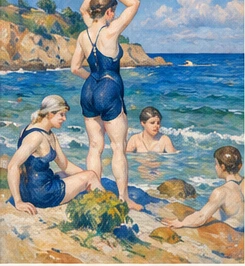
Even swimming has its conventions
Swimming provides a particularly clear illustration. Clothing can help with sun protection, warmth, hygiene in particular settings, or comfort; suitable swimwear has many practical uses. But it is also possible to swim without clothing, and rules demanding a bathing suit are often based at least partly on social convention rather than a universal physical necessity.
There is even a minor health irony: remaining in tight, wet swimwear for a prolonged period may cause skin irritation or contribute to some infections. That is not an argument that swimwear generally causes disease, and the evidence should not be stretched into one. It is simply a reminder that the familiar option is not automatically the most comfortable or suitable for every situation.
Different rules for different bodies
Dress expectations have not always been applied equally. Men have often been permitted to uncover parts of the torso that women were required to conceal. Other rules have depended on age, occupation, place, or prevailing fashion. Some distinctions are practical. Others reveal historical assumptions about gender and propriety that have changed over time.
The fact that a custom changes does not prove that it has no value. It does mean we should hesitate before declaring it an eternal moral rule. People can disagree about appropriate clothing without assuming that someone who prefers a different standard is inferior or dangerous.
Freedom is a relationship, not an unlimited license
Individual choice exists among other people with choices of their own. Schools, hospitals, workplaces, parks, and private homes have different purposes. The wishes of a person seeking freedom must be weighed alongside consent, safety, access, and others' reasonable expectations. Real freedom cannot be reduced to 'I should always be able to do whatever I want.'
The harder and more useful question is this: what actual harm is a rule intended to prevent, and is the restriction proportionate to that harm? Sometimes the answer will strongly support a restriction. Sometimes it may reveal that we are chiefly enforcing a habit. Examining the answer openly is itself an expression of respect.
In the novels
The characters in my adult novels repeatedly encounter rules about bodies, identity, authority, and what is considered normal. Their experiences invite readers to ask whose choices count and what happens when one group assumes its preferences should bind everyone. Related questions are explored more directly in The Dignity of Nudity and in the ethical issues surrounding human change in The Legacy of Venus and The Heirs of Venus.